Quick Verdict
History enthusiasts, architecture lovers and market visitors will appreciate the monument's Qutb Shahi design and its location beside Laad Bazaar.
Visitors unable to manage narrow staircases should skip the climb if available, although the exterior can still be viewed from public streets.
Table of Contents
- Overview
- History & Background
- Architecture & Design
- Key Attractions Inside
- Historical Significance
- Best Time to Visit
- Charminar timings
- Entry Fee & Tickets
- How to Reach?
- Guided Tours & Audio Guides
- Photography Rules
- Time Required
- Nearby Attractions
- Where to Stay & Eat
- Suggested Visit Itinerary
- Frequently Asked Questions
Overview
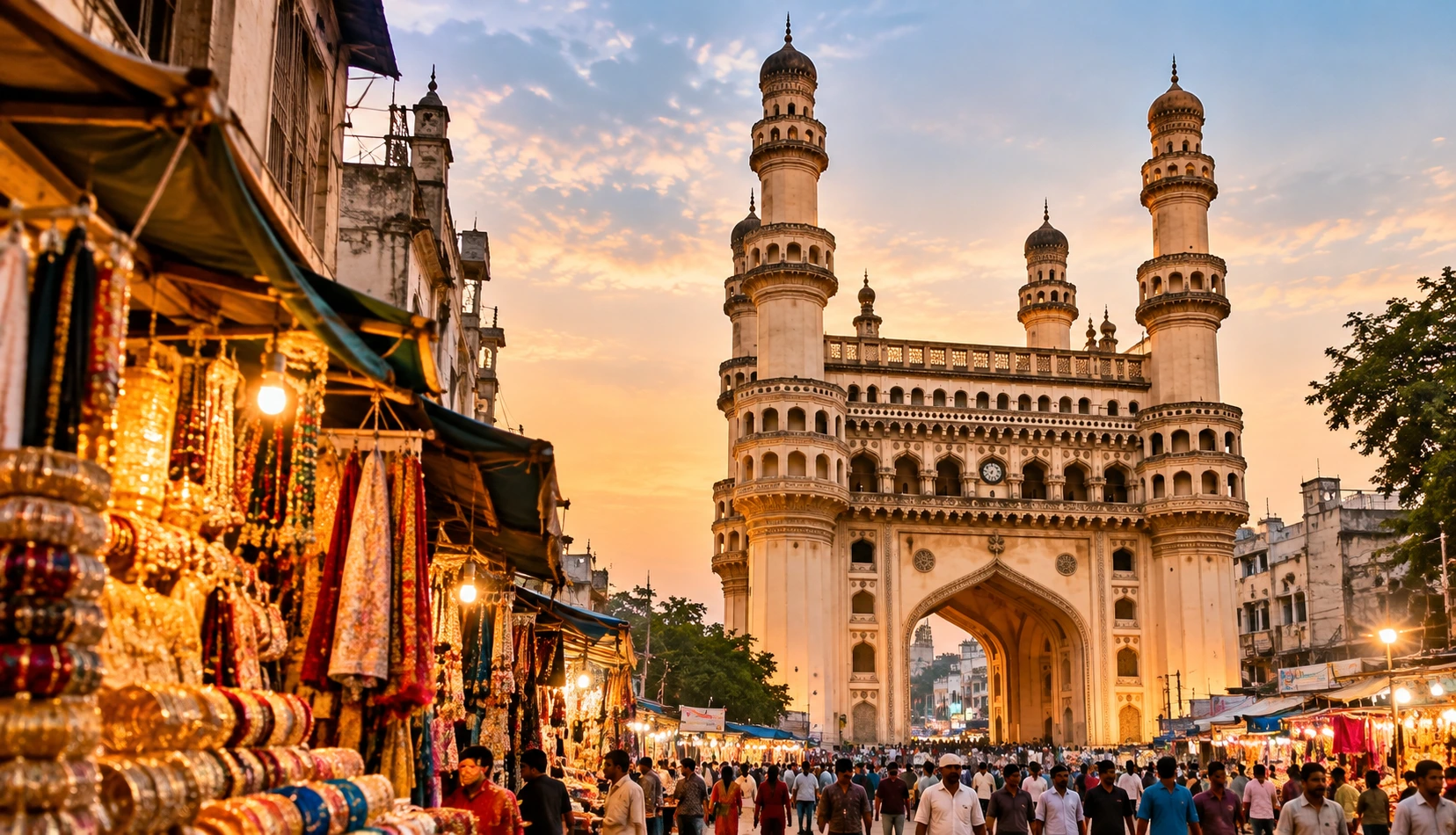
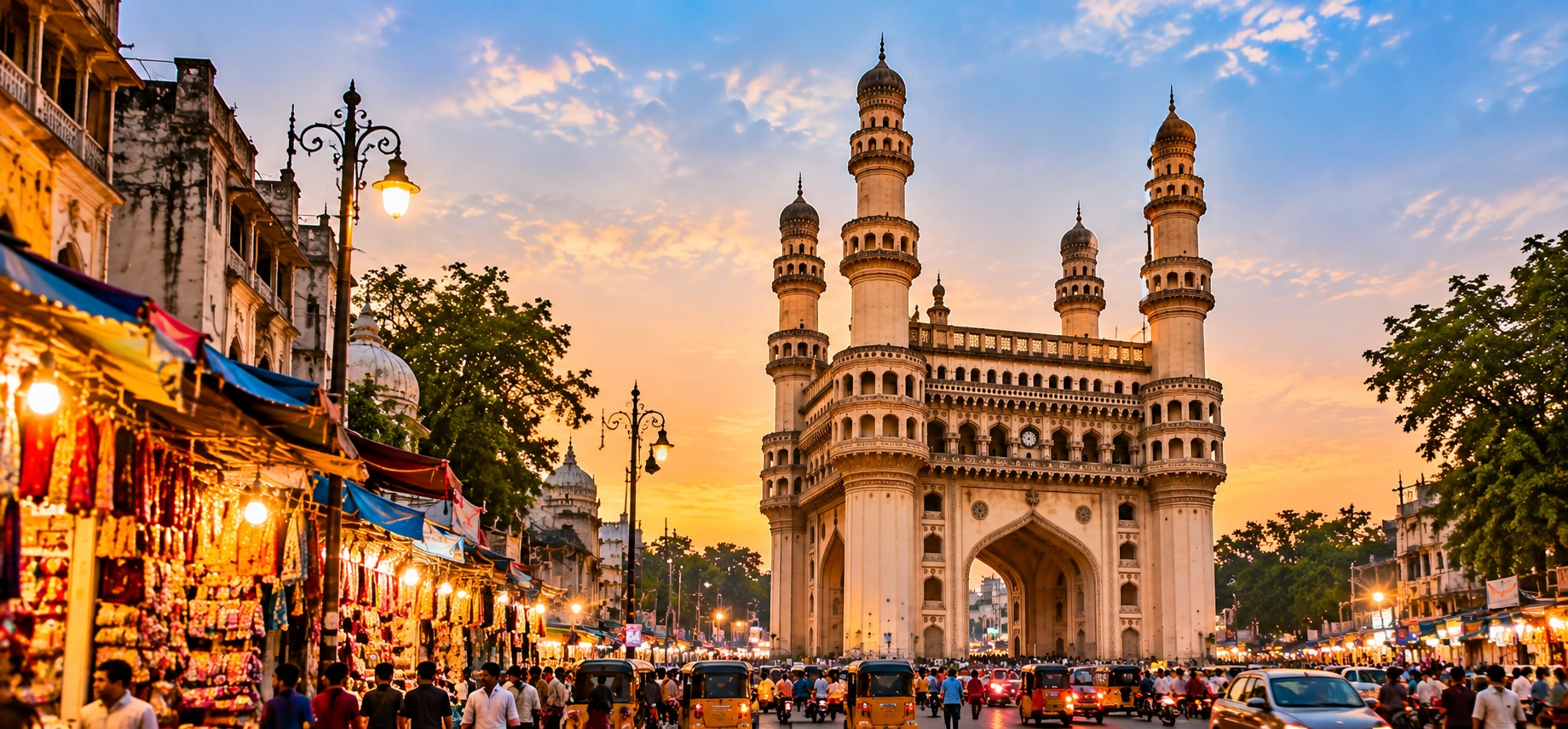
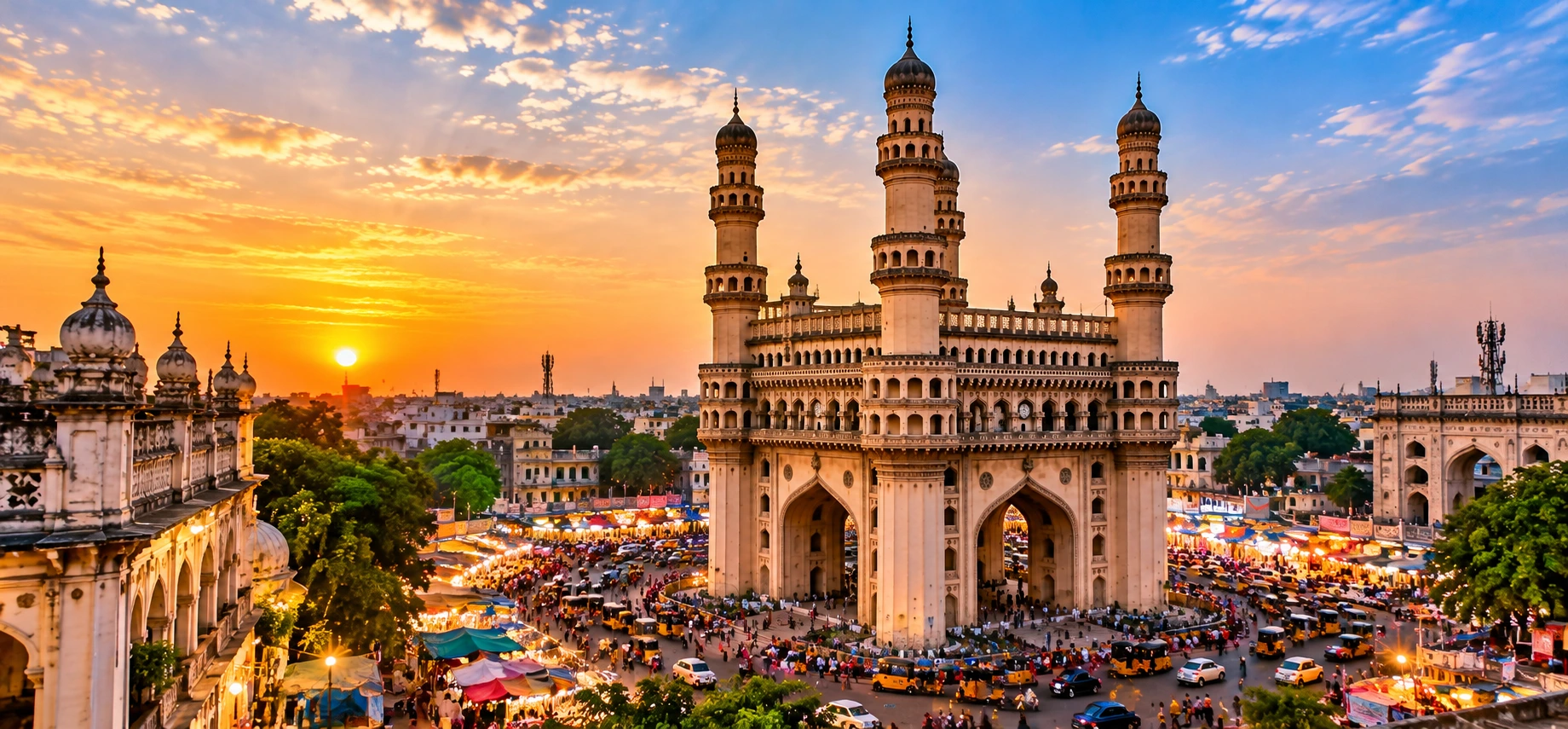
Built in 1591, Charminar is a historic monument in Hyderabad, Telangana, India, known for its four minarets and large arches. The structure stands at the meeting point of major streets in the Old City, surrounded by traditional markets, religious buildings and historic lanes.
Charminar was commissioned by Sultan Muhammad Quli Qutb Shah, the fifth ruler of the Qutb Shahi dynasty. It became a central landmark in the development of Hyderabad and remains one of the city's most recognised historic structures. Its square plan, carved decorations, four tall towers and upper-level mosque make it important to the city's architectural history.
The monument has four sides, each measuring approximately 20 metres. Its minarets rise about 48.7 metres above the ground. Visitors can examine the exterior arches, decorative details and historic clocks, while the surrounding streets provide access to traditional shops and local food.
Charminar timings are listed by Telangana Tourism as 6 a.m. to 10 p.m. However, access to the monument's upper levels follows separate visitor arrangements. The surrounding market area is generally busy, especially during weekends and religious festivals. The site suits visitors interested in architecture, history, photography and Hyderabad's traditional markets.
History & Background
Charminar was commissioned by Sultan Muhammad Quli Qutb Shah in 1591, when Hyderabad was being established as a new city beyond the older Qutb Shahi capital at Golconda. Construction began in 1589 and was completed around 1591, according to the Hyderabad district administration's historical account. The monument became the central reference point for the developing city.
Several explanations exist for its construction. A popular tradition connects the building with the end of a plague that affected the region. Another interpretation links it to the beginning of the second Islamic millennium in 1591. Historical accounts also connect its location with the foundation of Hyderabad. These explanations should be understood as different historical interpretations rather than a single universally established reason.
The monument is associated with Muhammad Quli Qutb Shah, who ruled the Qutb Shahi kingdom from 1580 to 1612. The architect is identified in Hyderabad district records as Mir Momin Astarabadi, a Persian official and planner who served the ruler.
Charminar underwent repairs after damage to one of its minarets by lightning in 1670. The damaged structure was subsequently repaired. Further renovation took place under Sikandar Jah in 1820, according to the district administration's historical account.
Four clocks were installed on the monument's exterior in 1889. These clocks became additional features of its design and remain an important part of its appearance.
The Archaeological Survey of India maintains the monument. Charminar is included in the Qutb Shahi Monuments of Hyderabad, Golconda Fort and Qutb Shahi Tombs entry on UNESCO's Tentative List, submitted in 2010. This is a tentative nomination, not a confirmed inscription on the UNESCO World Heritage List.
Architecture & Design
Charminar is a square monument built from granite and lime mortar, with four large arches and four minarets positioned at its corners. The design combines Islamic architectural forms with Persian influences and decorative features associated with the Qutb Shahi building tradition.
Each side of the structure measures approximately 20 metres. The four main arches face the surrounding streets and create open passages through the monument's lower level. These openings connect the building visually and physically with the historic road network around it.
The four minarets rise approximately 48.7 metres above the ground. Each tower has multiple levels, balconies and carved decorative bands. Their bases feature lotus-like forms, a design element associated with buildings from the Qutb Shahi period. The arrangement of arches and towers gives Charminar its distinctive four-sided appearance.
Stucco decoration covers parts of the exterior. Stucco is a decorative coating applied to a building surface, often shaped into patterns or relief designs. Floral motifs, ornamental details and carved elements contribute to the monument's appearance.
The upper part of the building contains a mosque with prayer spaces. Historical descriptions identify 45 prayer spaces associated with the upper-level mosque area. Access to the upper level involves a narrow winding staircase, traditionally described as having 149 steps. Visitors should follow the access arrangements in force when they arrive.
Four clocks were added to the outer faces in 1889. Together with the minarets and pointed arches, they help distinguish Charminar from other historic buildings in Hyderabad.
Key Attractions Inside
Four main arches: The large pointed arches face the four directions and form the main passages through the monument's lower level.
Four minarets: The towers rise approximately 48.7 metres and define Charminar's outline against the surrounding Old City buildings.
Upper-level mosque: The mosque occupies part of the upper structure and remains an important religious feature of the monument.
Winding staircase: The traditional staircase is described as having 149 steps, providing access towards the upper levels when visitor access is permitted.
Exterior clocks: Four clocks installed in 1889 face the surrounding streets and form part of the monument's historic exterior.
Floral stucco work: Decorative floral patterns and carved details appear across sections of the exterior and balconies.
Central courtyard: The courtyard includes a small ablution facility and fountain associated with preparation for prayer.
Historical Significance
Charminar is important because it marks the development of Hyderabad under the Qutb Shahi dynasty. Built in 1591, it stood at the intersection of major roads in the new city and served as a central point for its urban layout. Its position connected commercial streets, religious spaces and neighbourhoods within the historic settlement.
The monument also reflects the cultural and architectural traditions of the Deccan during the late sixteenth century. Its design combines Persian influences with regional decorative features and a distinctive arrangement of four arches and minarets.
The reason for its construction has several historical interpretations. The tradition linking it to the end of a plague remains widely repeated, while historical research also connects its date with the beginning of the second Islamic millennium. The monument's foundation inscription has been translated as a prayer for the growth and prosperity of the city.
Charminar continues to serve as a public landmark and a reference point for Hyderabad's Old City. The nearby Laad Bazaar and Mecca Masjid reflect the area's long association with commerce, religion and community life.
The monument is included in UNESCO's Tentative List as part of the Qutb Shahi Monuments of Hyderabad, Golconda Fort and Qutb Shahi Tombs proposal. Its tentative status recognises its historical and architectural importance without making it a formally inscribed UNESCO World Heritage Site.
Best Time to Visit
October to February is generally a comfortable period for visiting Charminar because Hyderabad's weather is usually cooler than during the peak summer months. Daytime temperatures can be high between March and May, making extended walks through the Old City less comfortable.
Early morning is a practical choice for examining the exterior and walking around the surrounding streets before the market becomes busier. Late afternoon provides changing light across the arches and minarets, while the illuminated monument attracts visitors after dark.
The area becomes particularly crowded during weekends, public holidays, Ramadan and Eid. These periods can bring heavier pedestrian traffic and changes to road access around the monument.
Visitors interested in architecture should allow time to examine all four sides rather than viewing the structure from one street. Those planning to shop at Laad Bazaar can combine the monument visit with a walk through the nearby market lanes.
Charminar timings
Telangana Tourism lists Charminar's general visiting hours as 6 a.m. to 10 p.m. daily. However, the monument's general access hours and the hours for entering the protected interior are not necessarily the same. Upper-level access can depend on the arrangements in force at the site.
Visitors planning to climb the staircase should arrive during daylight and allow time for entry procedures. Religious activities and special events can also affect access around the upper-level mosque and surrounding area.
The surrounding streets and market shops follow their own schedules, so shopping hours should not be treated as monument opening hours. Prices, hours and menus can change, so readers should check the official website before they go.
Entry Fee & Tickets
The entry fee for Indian visitors is listed at ₹20 per adult in available 2026 ticket records. and ₹250 per adult fee for foreign visitors. Visitors should distinguish the ticket for entering the protected monument from free access to the surrounding streets and markets.
Tickets have been issued through the Archaeological Survey of India's ticketing system. Online ticket availability and entry arrangements can vary, so visitors should use the official ticketing service where available or enquire at the entrance.
A ticket does not necessarily guarantee access to every level of the monument. Visitors should follow the instructions provided by staff and any restrictions applying to the upper staircase or mosque area.
Keep the ticket available during entry and carry identification if required by the ticket conditions. Children, concessions, camera charges and special entry arrangements should be treated separately unless included in the applicable ticket terms.
How to Reach?
By air: Rajiv Gandhi International Airport serves Hyderabad. From the airport, travel towards the Old City by road using a taxi or app-based ride. Travel time varies with traffic.
By train: Hyderabad Deccan station, also called Nampally, and Secunderabad Junction are major railway stations serving the city. From either station, continue towards Charminar by road or public transport.
By metro: Mahatma Gandhi Bus Station metro station serves the Red and Green lines and is one of the useful metro access points for the Old City. Continue towards Charminar by road or local transport.
By bus: Telangana State Road Transport Corporation buses serve the Old City. Mahatma Gandhi Bus Station is a major bus interchange, from which local buses and other transport connect to the Charminar area.
By road: Charminar is a recognised landmark in Hyderabad's Old City. Auto-rickshaws, taxis and app-based rides can reach nearby streets, although traffic restrictions and pedestrian crowds can affect the final approach.
Parking availability and access depend on the street and current traffic arrangements. During busy market periods, a short walk from the nearest accessible drop-off point can be necessary.
Guided Tours & Audio Guides
Guided visits to Charminar can form part of organised Hyderabad heritage tours. Telangana Tourism Development Corporation lists a city heritage and museum tour that includes Charminar, Mecca Masjid and shopping at Laad Bazaar, alongside other historic attractions.
The listed tour itinerary includes several stops across the city, so it is not the same as a dedicated tour inside Charminar. Tour prices and the inclusion of monument entry tickets can differ from the transport package price.
A dedicated official audio guide, its available languages, duration and current fee are Not publicly listed. Visitors who prefer a detailed explanation can look for an authorised guide through an official tourism operator or ask about available arrangements at the site.
Photography Rules
Photography of Charminar's exterior is a common visitor activity. The arches, four minarets, decorative details and surrounding streets provide clear subjects for architectural photographs.
Rules for photography inside the protected structure, including camera fees, tripods, flash equipment and video recording, are Not publicly listed. Visitors should follow any signs or instructions issued by site staff rather than treating exterior photography practices as permission for every interior area.
Drone use should not be attempted without the necessary permissions under applicable aviation and local security rules. The monument stands in a busy urban area, so visitors should avoid blocking pedestrian routes while taking photographs.
The upper-level mosque is a religious space. Visitors should respect worshippers, follow any restrictions on entry and photography, and dress appropriately when approaching religious areas.
Time Required
Allow around 1 to 2 hours for a visit focused on the monument and its immediate surroundings. This provides time to examine the exterior, take photographs, learn about the architecture and walk around the four sides.
A visit involving the interior staircase, when accessible, requires additional time for entry procedures and movement through narrow spaces. Access can depend on current visitor arrangements.
Allow another 1 to 2 hours if you plan to browse Laad Bazaar or explore nearby historic streets. Visitors combining Charminar with Mecca Masjid or Chowmahalla Palace should plan a longer Old City visit around the opening hours of each attraction.
Nearby Attractions
Mecca Masjid: A major historic mosque beside Charminar, known for its large prayer hall and granite construction.
Laad Bazaar: A traditional market near Charminar, known for bangles, jewellery, clothing and wedding accessories.
Chowmahalla Palace: A former palace complex associated with Hyderabad's Nizams, with historic halls and royal collections.
Salar Jung Museum: A museum containing collections of art, decorative objects and historical artefacts from several cultures.
Badshahi Ashurkhana: A historic religious building associated with the Qutb Shahi period and the city's Shia heritage.
Mahboob Chowk Clock Tower: A historic clock tower in the Old City that can be included in a walk through the surrounding heritage district.
Where to Stay & Eat
Stay
SR Residency: Khilwat, budget-oriented accommodation. Its location in the Old City makes it a practical option for visitors exploring the nearby historic streets.
The Metro International Hotel: Ghansi Bazaar, mid-range option. It provides a base for visiting central Hyderabad and the Old City.
Taj Falaknuma Palace: Falaknuma, upscale heritage hotel. The palace setting and historic architecture make it an option for travellers seeking a luxury stay outside the immediate market streets.
Accommodation prices and facilities vary by date and room type. Visitors should review the exact property details before booking.
Eat
Hyderabadi biryani: A rice dish prepared with fragrant spices and meat or vegetables, available at restaurants across Hyderabad.
Irani chai: Strong, milky tea traditionally served at Hyderabad's Irani cafés.
Osmania biscuits: Tea biscuits associated with Hyderabad's café culture.
Haleem: A slow-cooked dish made with grains, lentils and meat, especially associated with Ramadan in Hyderabad.
Double ka meetha: A local bread pudding prepared with bread, milk and sweet ingredients.
The surrounding Old City has restaurants, bakeries and tea shops. Food options range from quick snacks to full meals, with availability varying by establishment and time of day.
Suggested Visit Itinerary
First 15 minutes: Arrive near Charminar and view the monument from the outside, noting the four arches and the position of the minarets.
Next 20 minutes: Walk around the accessible sides of the building and examine the carved decorations, balconies and exterior clocks.
Next 20 minutes: Explore the courtyard and any interior areas open to visitors. Follow the current entry instructions for the staircase and upper levels.
Next 15 minutes: Take photographs from permitted public viewpoints while keeping the pedestrian routes clear.
Next 30 minutes: Walk through Laad Bazaar and browse its traditional bangles, clothing and jewellery shops.
Final 20 minutes: Continue towards Mecca Masjid or a nearby historic street, respecting religious access rules and the time available.